
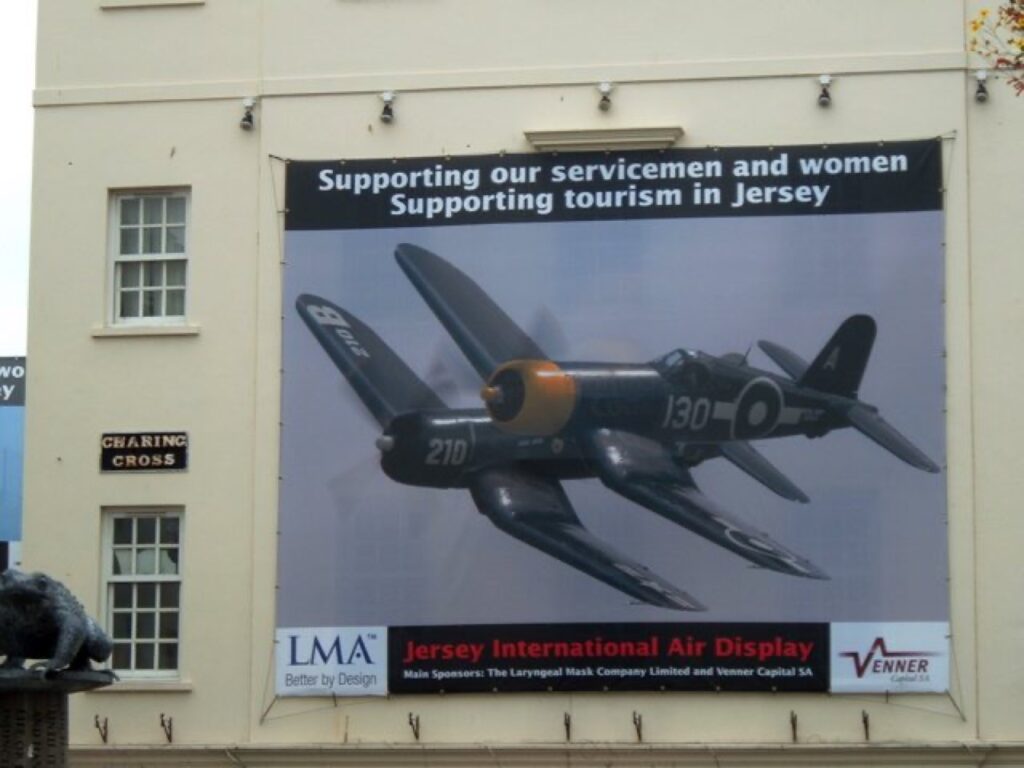
Most banners are made from one of three materials: PVC, mesh or fabric. All three print well in full colour and can be finished with hems, eyelets, pockets or bars. The differences are in how they behave once they are up: in wind, in rain, close to people and when they are packed away. Choosing the right one is mainly about where the banner will hang and for how long.
PVC banners
PVC is the all-round banner material. It is a coated, reinforced vinyl that is waterproof, tough and gives a solid, opaque surface with strong colour. It is the usual choice for shopfronts, railings, events and building fronts where the banner is fixed flat against a wall or held taut on a frame.
Strengths:
- Bright, dense colour and good legibility, front-lit or in daylight
- Waterproof and hard-wearing outdoors when printed with UV-resistant inks
- Can be hemmed and eyeleted for quick fixing with ties or bungees
Watch-outs: a solid PVC banner acts like a sail. On an exposed wall, fence or scaffold, wind load can tear eyelets or strain fixings. It is also heavier to handle and creases if folded rather than rolled.
Mesh banners
Mesh is PVC with a woven, perforated structure, so air passes through it. That makes it the right material for big banners on scaffolding, fences, gantries and the sides of buildings, where wind is a real factor. Our mesh banners have reinforced stitching around the edge and evenly spaced eyelets, and they are waterproof and flame retardant.
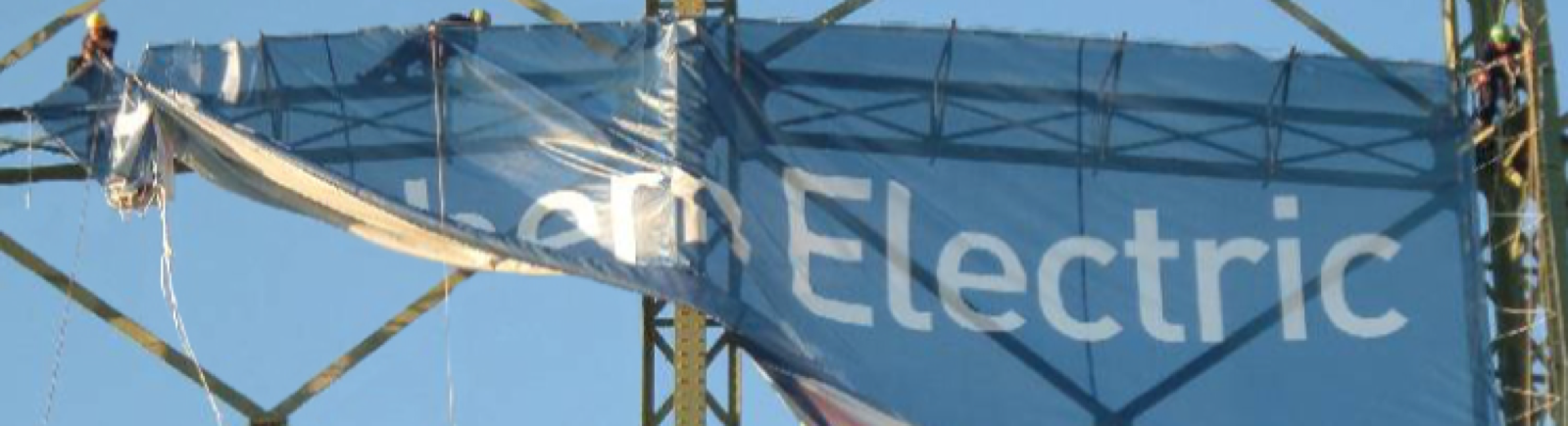
Because mesh has small holes, the print is slightly less solid than PVC when seen up close. From normal viewing distance for a large banner, the eye fills in the gaps and the image reads as continuous. Mesh suits big, bold images and headline text rather than fine detail meant to be read at arm’s length. See mesh banners for more.
Fabric banners
Fabric and flag banners are printed on textile. They are lighter than PVC, drape softly, have a matt finish with little glare under lights, and can be folded for transport with less risk of permanent creasing. That makes fabric the natural choice indoors: exhibitions, museums, receptions, event venues and stage backdrops, where a softer, more premium look matters.
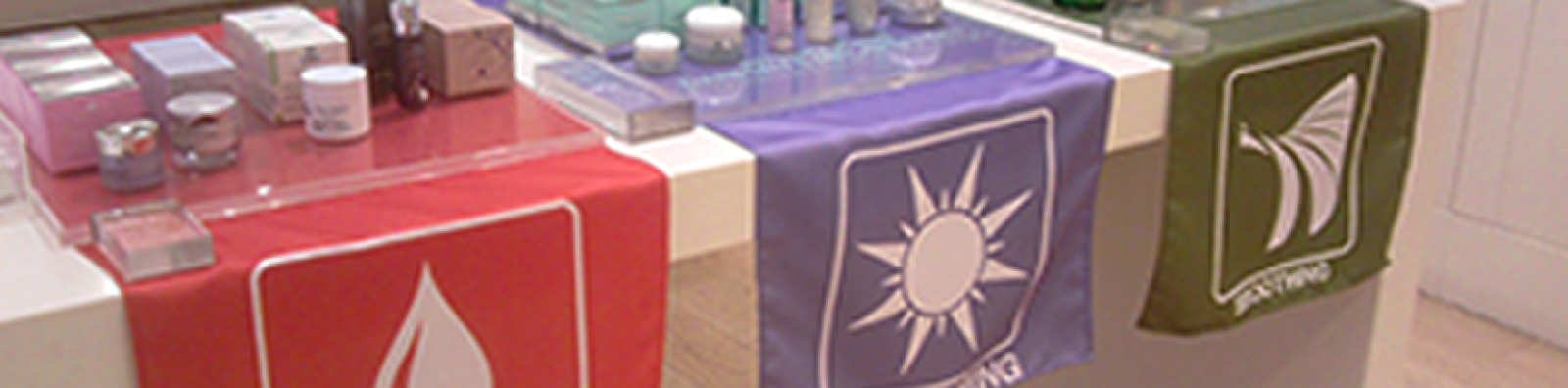
We print fabric and flag banners using UV inks that resist sun, scratching and moisture, and fabric is used outdoors for flags and some event work. For long-term exposure on a building, PVC or mesh is usually the more durable option. More on fabric banners and printed backdrops.
Side-by-side
- Exposed outdoor site, scaffold or fence: mesh first, PVC if the banner is small or sheltered.
- Shopfront, railing or wall, outdoors: PVC.
- Indoors, close to people, under lighting: fabric.
- Touring or packed away between uses: fabric folds; PVC and mesh are best rolled.
- Fine detail read up close: PVC or fabric rather than mesh.
Questions to answer before you choose
When you ask for a quote, it helps to tell us:
- Where the banner will hang, and whether it is indoors or out
- How exposed the spot is to wind
- How long it needs to stay up
- How it will be fixed: eyelets, pole pockets, a frame or ties (see how to hang a banner)
- Whether it needs to be seen from both sides
- Whether the venue or site has fire-safety requirements for materials
If you are not sure, describe the job and we will suggest a material and finish. Free material samples are available on request, so you can see and feel the difference before you order.
Finishing is part of the choice
The material decides how a banner behaves; the finishing decides how it is fixed. Every banner we make can have hems, eyelets, hanging bars or drop systems. For a very large banner on a building, the fixing plan matters as much as the material. Our banner printing team can handle printing, finishing, installation and removal, so you only need to tell us where it is going.
Next step
If you already know the size and where the banner will go, request a quote and tell us which material you have in mind, or ask us to price PVC and mesh side by side so you can compare. If your artwork is ready, send it to us and we will check it against the finishing you need, so nothing important ends up in a hem or behind an eyelet.
Questions
Is mesh always better than PVC outdoors?
No. Mesh is better on exposed, windy sites and on scaffolds and fences. For smaller banners on sheltered walls or railings, PVC gives a more solid, vivid print and is usually the better choice.
Can fabric banners be used outside?
Fabric and flag banners are used outdoors, and we print them with UV inks that resist sun and moisture. For long-term exposure on a building, PVC or mesh is generally more durable. Tell us how long it needs to last.
Are your mesh banners flame retardant?
Yes, our mesh banners are waterproof and flame retardant. If your venue or site needs specific certification, tell us when you ask for a quote so we can confirm.
Can I see the materials before ordering?
Yes. Free material samples are available on request.
Request a quote · Send artwork · 0203 026 0636